
by Daniel M. Dobkin
Elsevier-Newnes - Second Edition 2012
August 2021: Brian Degnan, Greg Durgin of Georgia Tech have joined the team to work on the third edition. Target release late next year. Lots of updates are planned, including a new chapter on locating tagged objects.
Radio-frequency identification is a catch-all term that covers a wide variety of technologies, from the low-cost passive ultra-high-frequency tags used in supply-chain tracking to 13.56 MHz tags inserted in a passport, or active WiFi-based transponders used to locate expensive assets in a hospital. The RF in RFID, now available from Elsevier-Newnes, focuses on UHF RFID, though a brief history and general introduction to the field is provided. The book is a greatly-expanded version of the tutorial found elsewhere on this site.
The book opens with an introductory chapter describing the general layout and approach of the book. Chapter 2 first reviews the history of RFID. After shamelessly repeating the internet myth about rolling fighter pilots as the first passive RFID tags (for which an archival confirmation is still pending -- if anyone has one, please forward it to me!), the story wends its way through the early research on active and passive transponders, including the remarkable early UHF work of Koelle and colleagues out of Sandia Laboratories.
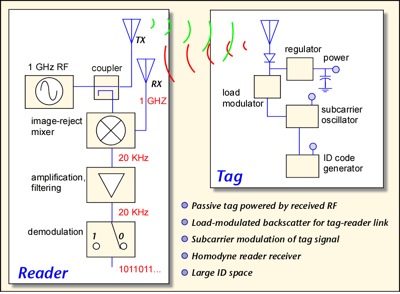
A review of early applications brings us to the present day, where we examine the different types of RFID, categorized by frequency, coupling, and power source, with some examples and example applications for each type. Chapter 3 surveys a potpourri of topics important to the analysis of radio links: waves, measurement of voltage and power, modulation and bandwidth, backscatter links, and the important topic of link budget calculations. Within the latter discussion we introduce the concepts of antenna gain and polarization, and arrive at the Friis equation for received power.
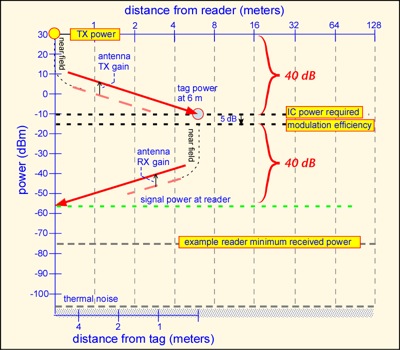
Chapter 3 also touches briefly on propagation, reflection, and fading. Chapter 4 deals with UHF RFID reader radios. We examine the elements of a radio -- amplifiers, mixers, oscillators, circulators, filters, and conversion between analog and digital signals. The parameters characterizing the performance of these components -- gain, power, noise, distortion, and so on -- each receive their moment of fame. We then put these components together to make an RFID transmitter and receiver, highlighting the key issues faced by the designer, including those unique to the homodyne architecture typical of such radios: specialized modulations for bandwidth-minimization in the face of dumb tag receivers, and conversion of phase noise to amplitude noise.
Chapter 5 is about passive UHF tags, peculiar beasts with special challenges for the circuit designer. Diodes and charge pumps serve to convert the reader's RF signal into power for the tag IC; switching the tag impedance allows it to talk back to the reader. This bit of analog circuitry supports a digital brain that must make do with a high-impedance, noisy, unreliable power supply. The circuit must be packaged on a plastic inlay and integrated with an antenna at cost levels that make children's toys seem expensive.
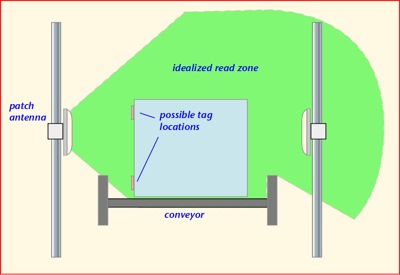
Chapters 6 and 7 discuss reader and tag antennas, key components in a working system. A more detailed discussion of antenna directivity and gain also seeks to clarify how gain arises from the changes of distance and thus phase with angle. Polarizations linear, circular, and undecided are introduced and the key role they plan in tag readability examined, and the interaction between antenna size, impedance, and bandwidth exposed. We take a close look at the patch antenna because of its dominant role for fixed reader applications. The last half of Chapter 6 views the various choices for reader antennas in the light of typical applications in portals, conveyors, and handheld configurations.
Tag antennas need to be tiny, cheap, robust, and efficient, and must power a high-impedance load (the tag IC) from a low-impedance wave. After a brief introduction to impedance matching, chapter 7 looks at various approaches to the problem: the meandered dipole, tip loading, shunt inductive matching, bowtie structures, and dual dipoles. We review antenna radar cross-section and provide a more realistic discussion of backscatter signaling, and look at the very important effects of the nearby environment on tag antenna operation. A discussion of the important scattering effects of other tag antennas includes a rather nifty and (as far as I know) previously unpublished formula for endfire array behavior as a function of antenna impedance. Finally, we discuss the interesting problem of producing a useful inductive loop (near-field) antenna at UHF frequencies.
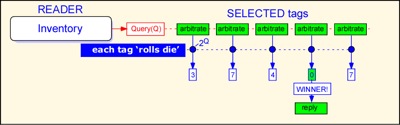
Chapter 8 takes a detailed look at how tag air interface protocols circumvent the stringent limitations of tag ICs. A review of protocol history reaches back to the days of reader-talks-first and up to the original Class 0 and Class 1 EPCglobal protocols; we even make an attempt to put some punch in ISO 18000-6B, despite the source document's status as reigning champion amongst insomnia cures. The last half of the chapter dives into EPCglobal Class 1 Generation 2, the protocol that seems likely to become the de facto worldwide standard for passive UHF tags. We discuss the slotted-Aloha Q protocol, dense-reader operation, and cheerfully conceal the shameless murder of innocent tags behind 32-bit passwords.
Readers familiar with the first edition of this book will find fewer minor errors, often courtesy of folks like themselves who brought said mistakes to my attention. New materials include a discussion of link budgets and wakeup challenges for active and battery-assisted tags, some recent progress in non-radiating antennas, an improved discussion of the T-match for tag antennas and some examples of near-metal antenna design, and coverage of battery-assisted and sensor provisions of ISO 18000-6, all in addition to the wholly new chapter 9 on Applications. References to ETSI EN 302 208 have also been updated. And now that I’ve received my copies, I can note that the second edition includes a number of new jokes and a song (or at least a poem, since I didn’t provide sheet music).
Each chapter includes a capsule summary and some suggestions for further reading, and is further adorned with exercises to test the reader's grasp of the material. The reader determined enough to peruse the exercises will meet Bob the lazy RF designer and his brilliant but too-often-ignored colleague Amy, encounter the age-old tradeoff between microwave adaptors and beer, and help Committee Chair Toulouse Track to resolve the frequent disputes surrounding the International Organization for Contention's STAR (Slothful-Tag-And-Reader) protocol. Finally, The RF in RFID sets a new standard for jokes hidden within the index, as the author continues in the Quixotic quest begun with RF Engineering for Wireless Networks to achieve the perfect balance of suspense and excitement with alphabetical reference materials.
Click here to go to the book’s page on Amazon. Thanks for your consideration!
If you already have the book and need answers to the exercises, click here.
Errata
Page 231, last complete paragraph: a passive tag consumes 4-5 MICROJoules, not milliJoules=mJ. It appears this one was added in proof: I wrote out “micro” in the submitted text in order to avoid problems with converting the Greek letter Mu to Latin alphabet m.
Page 475, second paragraph: should read “a local record-keeping means -- a passive tag -- can in principle...”. This was also added in proof, although the consequence is a mere grammatical infraction rather than substantive confusion as above.
Page 495, third paragraph, last sentence: should read “Thus, this requirement is about 0.5 dB more restrictive than the 36 dBm EIRP requirement used in the US.” This one is my mistake. I got it right on the previous page, too -- what was I thinking? Thanks to Reinier Gerritsen of IDcircuits for pointing this out.