
The RF in RFID: physical layer operation of passive UHF tags and readers
Daniel M. Dobkin
(revised December 2012 minor fixes December 2025)
1. Introduction
RFID is an acronym for radio frequency identification: the use of wireless communications to establish the identity of a physical object. For the reader who is unfamiliar with the technology and business of RFID, there are many good introductions to RFID already available on the web; links are provided below to some of them. The purpose of this document is to go into some more depth on how such devices actually work. We focus here on passive transponders (tags): that is, tags with no power source other than the radio frequency power provided by the interrogating device (reader). The discussion is also specific to tags and readers operating at high enough frequencies that significant radiation occurs: for typical antenna sizes, operating frequencies over about 200 MHz ensure radiative coupling. (We do provide a brief discussion of near-field reader antennas, which rely on inductive coupling but operate at high frequencies.) The most commonly used frequencies are in the UHF band; see RFID frequencies for more information.
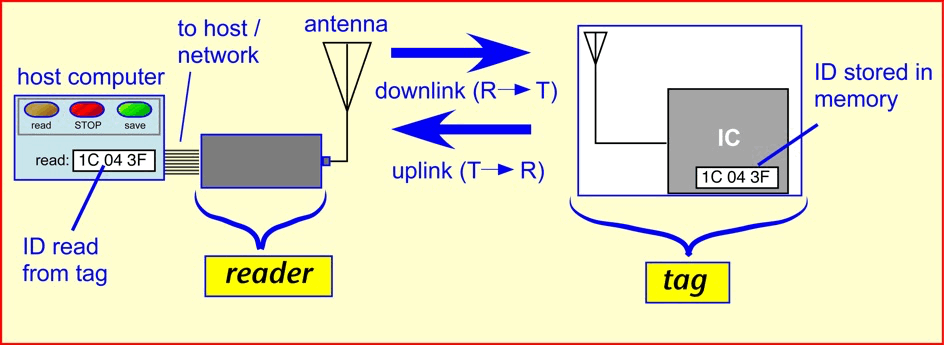
A schematic image of a passive RFID system is shown below: a reader illuminates one or more tags, each containing a unique identifying number. The tags must use the power they receive to operate their integrated circuits and return a signal with their ID to the reader.
Key questions that arise in designing such a system are:
Link budgets:
- How much power do we need to transmit?
- How much signal do we need to successfully decode a message?
- What limits the read range?
RFID Readers:
- What is inside a reader?
RFID Tags:
- What is inside a tag?
RFID Protocols:
- How does a protocol work?
RFID Frequencies:
- What radio frequencies can we use? How does that choice affect system operation and performance?
February 2023: Note that there are a number of old-time .swf videos on the site. These can still be viewed using (at least) the Elmedia video player, available for Mac and Windows computers.
Places to go for RFID information:
Coming up: IEEE RFID 2026 https://2026.ieee-rfid.org/
This year the conference will be held in Santa Fe, New Mexico, US, June 16-18. The conference will begin with tutorials, including an updated version of the information found here! A number of special sessions will also be included. The paper that I did at the 2025 conference with Christopher Saetia and Professor Gregory Durgin can be found at https://www.youtube.com/watch?v=OurTjQmEHIs.
On the web:
GS1 RFID https://www.gs1.org/standards/epc-rfid
AIM Global https://www.aimglobal.org/rfid-experts.html
RAIN RFID https://rainrfid.org/
IEEE RFID Conferences: https://2025.ieee-rfid.org/
Books:
RFID Handbook (2nd edition), Finkenzeller, Wiley 2010. Introduction to RFID technology and standards, focused on HF. Very thorough but not easy if the field is new to you. Complementary to my book.
The RF in RFID (2nd edition), Dobkin, Elsevier 2012. See the linked page for more info.
RFID Sourcebook, Lahiri, IBM Press 2006. This is an excellent book for getting started. It is not very technical, and contains a lot of checklists and practical implementation advice, as well as a list of more standards than you ever want to use or read.
RFID Field Guide, Bhuptani and Moradpour, Sun / Prentice-Hall 2005. Not technical but useful information on markets and implementation.
RFID Security, Thornton et. al., Syngress 2006. This is something of a collection, so the style and quality vary from chapter to chapter, but with sections well worth knowing about for implementers, particularly since vendors are rarely going to describe the security vulnerabilities of the technology they sell.
RFID Applications, Security, and Privacy, eds. Finkenzeller and Rosenberg, Addison-Wesley 2006. Another collection with varying article quality, but some real gems are included.
Return to the RFID Index